Writing a book that is and is not the story of my father
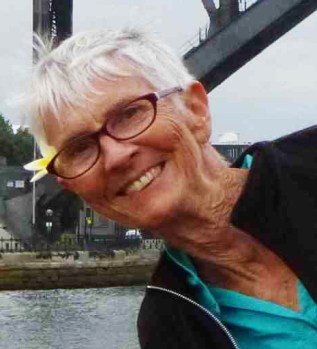
Author: Pamela Collett
I was born and raised in Kansas City, Missouri. I have a B.A. from Stanford University and a M.Sc. from Cornell University. I have lived and worked in San Francisco, Berkeley and Oakland, California as well as in Washington, DC. Outside the United States, I lived and worked in Venezuela, Pakistan, Afghanistan, China, Uganda, Somalia and Kenya. I currently live in Canberra, Australia.
I edited three books: Bold Plum: with the Guerillas in China's War against Japan by Hsiao Li Lindsay; Peace and Milk: Scenes of Northern Somalia by James Lindsay and Fatima Jibrell; and Solo vale si piensas rápido by Mehedy Lopez, a book of poetry in Spanish. In 2016, I published a book of my poetry and drawings, Silence Spoken.
I have taught communication skills, English as a second language, and English for journalists (in Beijing, China) at university and secondary school levels. I was a features writer for the Daily Journal, (Caracas, Venezuela), and The Chronicle of Higher Education. I am a member of the ACT (Australian Capital Territory) Writers Centre, active in a writers’ group and a contributor to poetry readings, That Poetry Thing, in Canberra, Australia.
Poems in the haze of bushfires
25-27 December 2019
Camping at Pinch River, Kosciusko National Park NSW
25 December 2019
Blue sky above
after weeks of
smoky haze
The world on fire
or at least
a continent on fire
The glory of clouds
only visible when
against blue sky
The sun
shining through
spreading out
its rays
after days
as a red ball
surrounded by
grey smoke haze
The sounds of
the river
and the cicadas
Pinch River, Kosciusko National Park, Australia
In the stream
water rushing over
a rock dam
Cicadas crescendo
Orange ball sun
Shrouded in smoke haze
Bushfire season
Cleaner birds
Black feathers
Red eyes
White tipped wings
when in flight
Waiting in trees
Will they drink
at the stream
if I leave
Dried up forest
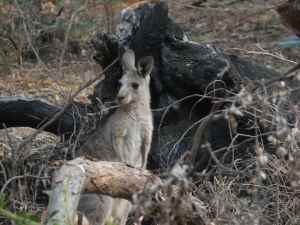
Adult kangaroo
Two juvenile roos
Forage by the creek
Juvenile Kangaroo foraging by the stream
Stream colour changes
brown green gold
Boulder colour changes
grey blue orange pink
The sun decides
I urge myself to write
after days in a daze
due to a head cold
the aftermath to
sitting in a tent for hours
at the Majors Creek Festival
(a tiny historic gold mining town,
301 km south of Sydney and 16 km south of Braidwood in New South Wales, Australia), listening to Emily Rose and the Wild Things (high energy) followed by Great Aunt, a folk duo on guitar and bass (quiet competency).
I have lost the plot. What did I want to say about Kei Miller’s two novels?
See my blog https://bettehutchisonsilver.wordpress.com/2019/11/01/you-never-know/ about meeting Kei Miller, the poet.
Inspired, after meeting Kei Miller at the Poetry on the Move festival in Canberra, I found two of his novels at the local public library:
The Last Warner Woman
and
Augustown
The title of The Last Warner Woman confused me. When I see the word “Warner”, I immediately think of two brand names: Warners bras and Warner Brothers, a film production company.These are brands I grew up with in the USA. I have never consciously thought of either one - perhaps in my entire life (although I have seen the WB logo of Warner Brothers in movie credits). I have never bought a Warners bra.
So I wondered why a writer from Jamaica would write about Warners bras or Warner Brothers? The cover of the book did not relate to the Warner brands. Think about it. Shocking that a word “warner” became embedded in my mind with two brands. The power of advertising that changes the lens through which we understand words.
Warner… means a person who warns… that is, a seer or prophetess.
A warner is someone who can “see” what is going to happen and then warn people.
This book is as beautiful as the cover. The writing is so evocative that I had to read it carefully - word by word - the way I usually read poetry.
I often speed read novels. Satisfied with understanding the main story line, following the principal characters and immersing myself in the story without carefully reading each word. Not possible to speed read The Last Warner Woman.
And then Augustown
Augustown started slower for me. Something ominous surrounded the people in the novel. Something was going to happen. I read the novel with anxiety. At one point I put it aside. I didn’t want to know what was going to happen next.
Both books are based on Jamaican history and folk lore.
After reading Augustown, I looked up “Bedward“ and found the following:
“Between 1891 and 1921, Alexander Bedward, an African-Jamaican healer, led the Jamaica Baptist Free Church in August Town, Jamaica, on the Hope River. . .
In the 1930s, Bedwardites and Garveyites transformed Bedward's millenarianism into the more antiestablishment and durable Rastafarian movement…”
https://www.encyclopedia.com/history/historians-and-chronicles/historians-miscellaneous-biographies/alexander-bedward
Enjoy!
QandA is a weekly current affairs program on ABC TV in Australia The 29 October 2019 broadcast focused on responses to the current ongoing, multi-year, devastating drought
Logo of QandA
QandA Panel
Sitting at one end a middle-aged water woman, assertive in a quiet, fact-based approach explaining the mismanagement of scarce water resources
Next to her a government minister, nothing to be proud of, prattling on, talking much, saying little
The government minister sandwiched between the water woman and an eloquent, emotional young farmer, her face bent to listen to other panelists, her responses always from her heart, faithful to the land
In the middle of the panel
The moderator, looking rather young, a half smile on his face, eyes open wide, trying to hold things together without losing his composure
Next to him
A blonde, curly-headed woman wearing an all green shirt (but she’s not a member of the Greens), the head of the Farmers Federation, talking, even interrupting the water woman, but with nothing much to say except pity the farmers, defending the status quo, offering no analysis, no vision, no future
And last but somewhat least the shadow minister for labor, talking about the poor farmers doing it tough, saying Australia needs a national drought plan without offering one
QandA Studio Audience
The QandA panel floating on a sea of climate change and drought, with the audience and farmers (in the studio and on video links) critical of the dismal performance of current governments
The audience and farmers acknowledging human-made climate change and the mismanagement of very scarce water resources
The audience applauding the eloquence, the heartfelt sentiments of two indigenous leaders – one on video, one in the audience – denouncing corporate greed and capitalism that has taken their water
In the audience – connections to the land, to reality, to caring in stark contrast to the empty words of three members of the panel
Talking with the delivery guy
about farming
He smells of cigarettes
I want to tell him
to stop smoking
But I don’t
I listen and find out
His was a farming family
Hard life
Father told him
Don’t be a farmer
So he’s a delivery person


Thinking about land
every day
The destruction
of Mother Earth
Thousands of hectares
every day
deforested in Australia
Trees cut down
Amazon burning
As one youth activist
quipped on a poster
The wrong Amazon is burning

I don’t even know
what a hectare is
I have never lived
on a farm
I have lived
in cities and towns
on six continents

Hiking in the bush
just outside town
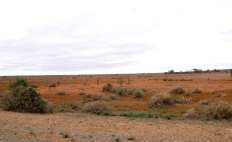
I see parched earth
Erosion
like the deep cut
on my arm
But the cut was
sewed up
closed up
Now healed
Leaving only a slightly
pink and purple scar


How to heal the earth?
Some farmers know how
The earth can be renewed
But forcing the land
to yield immediate results
leads to
long-term destruction
Farmers becoming
delivery people
Previous to this trip researching about my father’s life for my novel, Tracking the Human: nobody’s a long time, I had never spent time in Oklahoma. Whenever I heard the word “Oklahoma”, I thought of the musical.
Oklahoma! is the first musical written by the well-known team of composer Richard Rodgers and librettist Oscar Hammerstein II. The musical is set in Oklahoma Indian Territory outside the town of Claremore in 1906. The original Broadway production of Oklahoma! opened on March 31, 1943 and was a box-office smash. (source: Wikipedia).
One summer during my childhood in Kansas City, Missouri, my parents bought season tickets to the Starlight Theatre in Swope Park. Starlight Theatre has an outdoor stage and seating. It has operated continuously since 1951. Having been renovated several times over the decades, Starlight currently has a capacity of about 8,000 people. I saw Oklahoma! at the Starlight Theatre.
I consider myself tone deaf and have a poor memory for music. But somehow, even after many decades, I can still hear the lyrics of Oklahoma! somewhere inside my head.
The lyrics come bouncing back, instantaneously when anyone mentions the word Oklahoma.
Ohhhklahoma, where the wind comes sweepin’ down the plain
And the wavin’ wheat can sure smell sweet When the wind comes right behind the rain.
But I only remember the opening lines (above) and the ending
You’re doin’ fine, Oklahoma!
Oklahoma O.K.
As a child, I never thought much about Oklahoma as being the birthplace of my father, W. Lon Hutchison, and the home of my grandmother, Letha Yates. She was occasionally mentioned and even visited us once in Kansas City. There was never any mention of any grandfather, aunts or uncles.
For me, Oklahoma was a mythic place, based on the musical, much as Kansas is considered by some to be mythical based on the book, The Wizard of Oz.
Having visited a small corner of northeast Oklahoma looking for information about my father and his family, do I think I “know” Oklahoma? Of course not. The words of the musical are indelibly linked in my mind and have not been erased or subsumed by my visit.
Well I do know you, don’t I? Otherwise, why did you jump off the shelf in the Kingston public library in Canberra, Australia, into my hands? I took a quick look at the end flap on the front cover of the book All the Lives We Ever Lived. Then I put it on the automatic checkout machine and out the door the book went with me.
The tagline to the title of the book “Seeking solace in Virginia Woolf” did not speak to me. I read Virginia Woolf when I was young and determined to be an intellectual who had read all of the “important” books. I vaguely remember reading A Room of One’s Own, by Virginia Woolf which resonated with me because of its assertion of women’s equality. However, I don’t remember becoming attached to either the work or life of Virginia Woolf.
But this book, All the Lives We Ever Lived, sought me out. I knew nothing about it or about the writer. I saw it by chance sitting on the library shelf and brought it home. I started reading. And I kept on reading every day until I finished it. I felt a bit dissatisfied with the ending. I was hoping that the book never ended so I could continue our one-sided conversation with me listening while the author, Katharine Smyth kept talking. As a reader/listener I was never bored, nor did I skip paragraphs or pages. I read/listened diligently.
Throughout the book, Virginia Woolf was present but not dominant. She added an extra dimension to the memoir Katharine Smyth wrote about her life, her father, her family and her attraction to Woolf’s book, To The Lighthouse.
Her relationship to her father was very unlike mine to my father. She was close to her father and shared many activities, including sailing, with him. My father was distant and controlling. I never really knew him, although I should have.
I am researching and writing a novel Tracking the Human: nobody’s a long time based on events in his life. All the Lives We Ever Lived offers no guidance to the work I am trying to write. Nor should it. For my family, the title might be All the Lives We Never Lived.
Katharine Smyth glories in the written word and the production of art. “Art may not give us the unequivocal truths that we desire from our world, but it can provide a stay against its chaos and confusion.” p. 186.
She speaks to me in my ongoing need to read, read, read, to find myself and to be myself, whoever that may be. “And is not the sight of ourselves laid bare on the page – endlessly complex, and yet not singular at all – one of reading’s humblest, most delightful rewards?” p. 243.
Thank you, Katharine. I thoroughly enjoyed our conversation.
Rounding a corner

from a gallery exhibition

Walking up a ramp

with no destination

Black tiled floor

Grey cement walls

Polished silver handrails

Blinking white floor lights

Triangular window

looking down on fern palms

in a secret garden below

No paintings or people visible

in the crowded museum

Silence

only my own footsteps

and the distant click clack

of someone’s high heels
In Tulsa Oklahoma in the 1925 probate records of my grandfather, E.S. Hutchison (the murdered “Love Pirate”), I discovered that W. Lon Hutchison, my father, the firstborn child, had been disinherited by his father. Many decades later, my father did the same to his firstborn child – me. In this family history, I found a pattern of revenge and rejection that I want to change.
That’s why I went on this journey – to uncover the mysteries of my father’s life as a basis for reconciliation. The journey has an end point: writing a novel, Tracking the Human: nobody’s a long time, based on events in my father’s life.
Continuing my search for information, I left Tulsa, Oklahoma and drove to Krebs. I could hardly tell where the larger town of McAlester Oklahoma ended and the tiny town of Krebs began, except for a sign, The City of Krebs welcomes you.
My father was born in Krebs in 1907, when Oklahoma was still Indian Territory. Today Krebs is a very small town in what was once coal country.
The population of Krebs is about 2,000. Because of several restaurants and a specialized grocery story, Krebs has chosen the nickname “Little Italy”.
According to Wikipedia, Krebs was founded in the late 1800s. The first post office was established in 1886. The town began as a coal-mining camp, housing European immigrants who came to work in the mines.
Street scene, Krebs, Oklahoma
On January 7, 1892, an explosion in the Osage Coal & Mining Company’s No. 11 mine killed 100 workers and injured another 150.
Here’s a photo of the memorial to that explosion listing all those killed in the coal mine explosion.
I visited the Krebs Heritage Museum, a hodgepodge of stuff from peoples’ attics. I found a record of the birth of the Gilpin girls – my grandma’s maiden name, but nothing more. I bought a tee shirt of the Krebs Heritage Museum and went to look for a cheap motel to spend the night.
The next day I left Krebs to drive back to Vinita to find out if the woman at the Forensic Center had found any records relating to my dad… She hadn’t.
Weary of travel and digging for information, feeling somewhat frustrated, I drove back to my friends’ home, outside Lawrence, Kansas.
I had gone to the Tulsa County Court House to try to find out more about my grandfather’s killer. Instead at an annex, I found probate records of my grandfather’s estate. I was surprised by the size of my grandfather’s estate, (over $200,000, a sizable fortune in 1925) and that he had disinherited his first born child, my father.
Disappointed that I hadn’t been able to find out more about my grandfather’s killer, my next stop was nearby – the Roseville Cemetery.
Through online records I found out that my father had been buried at the Roseville Cemetery. I got there while the cemetery was open, but the office was closed. In the very extensive grounds, I could not find my family’s burial plot. There was no guiding information posted. It would have to wait for the next day.
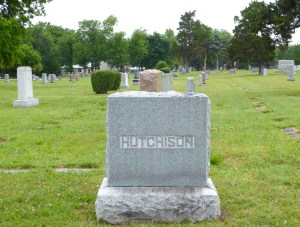
The next morning, the office was open and I got directions to my family’s burial plot. With some difficulty, I eventually found the Hutchison family plot. The Hutchison plot was right next to the Purdy family plot, which was the surname of my grandfather’s killer.
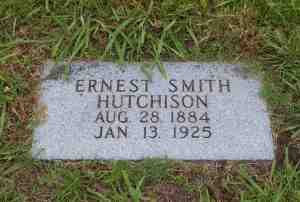
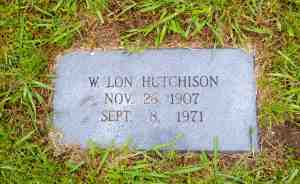
I avoid cemeteries and have never attended a funeral, but I stayed awhile, talking out loud with everyone who is buried there, including my dad. There were gravestones for my grandfather, grandmother, great uncle, uncle, aunt and my father.
Gravestone of my grandfather, the murdered “Love Pirate”
I went from grave to grave, greeting each person. I spoke with each of them and shared what I was doing. I told them I was researching my father’s history to understand the man I didn’t know and that I was writing a novel, Tracking the Human, based on events in his life. I explained to them that my project was a work in progress for reconciliation for all of us.
Gravestone of my father
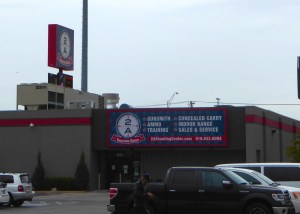
Driving out of the Rosehill Cemetery, I noticed a gun shop and firing range directly across the street.
Gun shop across the street from Roseville Cemetery
My next stop would be Krebs, Oklahoma, a very small town just outside McAlester Oklahoma, where my father was born in 1907. I had no particular leads, but thought I would go and take a look at his birthplace.


 This book is as beautiful as the cover. The writing is so evocative that I had to read it carefully - word by word - the way I usually read poetry.
I often speed read novels. Satisfied with understanding the main story line, following the principal characters and immersing myself in the story without carefully reading each word. Not possible to speed read The Last Warner Woman.
And then Augustown
This book is as beautiful as the cover. The writing is so evocative that I had to read it carefully - word by word - the way I usually read poetry.
I often speed read novels. Satisfied with understanding the main story line, following the principal characters and immersing myself in the story without carefully reading each word. Not possible to speed read The Last Warner Woman.
And then Augustown
 Augustown started slower for me. Something ominous surrounded the people in the novel. Something was going to happen. I read the novel with anxiety. At one point I put it aside. I didn’t want to know what was going to happen next.
Both books are based on Jamaican history and folk lore.
After reading Augustown, I looked up “Bedward“ and found the following:
“Between 1891 and 1921, Alexander Bedward, an African-Jamaican healer, led the Jamaica Baptist Free Church in August Town, Jamaica, on the Hope River. . .
In the 1930s, Bedwardites and Garveyites transformed Bedward's millenarianism into the more antiestablishment and durable Rastafarian movement…”
Augustown started slower for me. Something ominous surrounded the people in the novel. Something was going to happen. I read the novel with anxiety. At one point I put it aside. I didn’t want to know what was going to happen next.
Both books are based on Jamaican history and folk lore.
After reading Augustown, I looked up “Bedward“ and found the following:
“Between 1891 and 1921, Alexander Bedward, an African-Jamaican healer, led the Jamaica Baptist Free Church in August Town, Jamaica, on the Hope River. . .
In the 1930s, Bedwardites and Garveyites transformed Bedward's millenarianism into the more antiestablishment and durable Rastafarian movement…”

 Thinking about land
every day
The destruction
of Mother Earth
Thousands of hectares
every day
deforested in Australia
Trees cut down
Amazon burning
As one youth activist
quipped on a poster
The wrong Amazon is burning
I don’t even know
what a hectare is
I have never lived
on a farm
I have lived
in cities and towns
on six continents
Hiking in the bush
just outside town
I see parched earth
Erosion
like the deep cut
on my arm
But the cut was
sewed up
closed up
Now healed
Leaving only a slightly
pink and purple scar
Thinking about land
every day
The destruction
of Mother Earth
Thousands of hectares
every day
deforested in Australia
Trees cut down
Amazon burning
As one youth activist
quipped on a poster
The wrong Amazon is burning
I don’t even know
what a hectare is
I have never lived
on a farm
I have lived
in cities and towns
on six continents
Hiking in the bush
just outside town
I see parched earth
Erosion
like the deep cut
on my arm
But the cut was
sewed up
closed up
Now healed
Leaving only a slightly
pink and purple scar
 How to heal the earth?
Some farmers know how
The earth can be renewed
But forcing the land
to yield immediate results
leads to
long-term destruction
Farmers becoming
delivery people
How to heal the earth?
Some farmers know how
The earth can be renewed
But forcing the land
to yield immediate results
leads to
long-term destruction
Farmers becoming
delivery people


 Rounding a corner
from a gallery exhibition
Walking up a ramp
with no destination
Black tiled floor
Grey cement walls
Polished silver handrails
Blinking white floor lights
Triangular window
looking down on fern palms
in a secret garden below
No paintings or people visible
in the crowded museum
Silence
only my own footsteps
and the distant click clack
of someone’s high heels
Rounding a corner
from a gallery exhibition
Walking up a ramp
with no destination
Black tiled floor
Grey cement walls
Polished silver handrails
Blinking white floor lights
Triangular window
looking down on fern palms
in a secret garden below
No paintings or people visible
in the crowded museum
Silence
only my own footsteps
and the distant click clack
of someone’s high heels




 Tracking the Human: nobody's a long time