Who is the Queen of Australia?

What?

You didn’t know that Australia has a queen?

Well, the Queen of Australia is not Australian.

The Queen of Australia is…..

The Queen of England…

Yes, indeed folks.

So if and when you become a naturalized citizen of Australia you are supposed to pledge allegiance to the Queen (of England). This is irksome, if you don’t believe in royalty and you do believe in social equality. Very irksome.

Australians have been trying to do something about this anomaly for some time now.

According to the book This Time by Benjamin T. Jones, “Republican voices have been heard since the early colonial days (in Australia) but they were never mainstream.” Jones documents the first Republican Campaign in Australia in 1850.
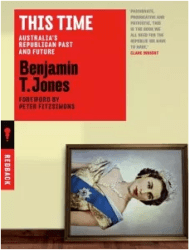
As an Australian citizen born in the USA, the fact that Australia still is NOT a republic and that the head of state is the Queen of England is almost unbelievable.   In terms of everyday life, it would seem that the Queen does not play that significant a role.

But look again, as Jones does in This Time, an easy-to-read, well-documented book about Australia’s Republican Past and Future. http://benjaminthomasjones.com/new-book-this-time-australias-republican-past-and-future/

Look again at the symbols that surround us in our everyday life in Australia.

The flag: the Union Jack is in the upper corner of the Australian flag. So what is Australian about this flag? We need a new flag. Ausflag is a non-profit organization working towards a new flag. Many beautiful and appropriate designs have been submitted to their website. Check it out at www.ausflag.com.au
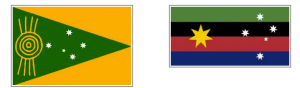
Just two of many beautiful designs submitted to http://www.ausflag.com.au

Jones noted, “For many Australians, the relics of empire and monarchy are so ubiquitous that they become invisible. ” For those of us NOT born  in Australia of British background, it is quite noticeable. I already mentioned the flag, which is British rather than Australian. The coins all have the Queen of England on them, as does the five-dollar bill.

Three of the five states have British names: New South Wales, Victoria and Queensland. As noted by Jones, “Every major city, and indeed most regional towns, have a central business district marked with George, Edward, Victoria and Elizabeth streets, in honour of royals past and present”. Jones asks, “What constitutional model and national symbols best represent modern Australia?”

All Australians and people interested in Australia are encouraged to read this book and think about “What does it mean to be an Australian?”

Your comments are always most welcome.  Thank you.

Lost without a title

Trying to write a novel without a title overwhelmed me. I was in the process of writing and preparing to publish a novel based on events in the life of my father, W. Lon Hutchison, from his birth in 1907 in Indian Territory, soon to become the state of Oklahoma, to his death in 1971 in Kansas City, Missouri, when the title of my book  Life Expectancy abandoned me.

What had I done so far?

And writing is  always far… in time, in work, in travel, in research… very far.

I researched on location and in libraries in Oklahoma, Kansas, Missouri, the National Archives, Kansas City, Missouri, Oakland, and San Francisco, California.

I wrote and rewrote chapter by chapter with feedback from a monthly writers’ group. I researched small independent publishers of fiction in the USA who accept queries. I was ready to start my blog and send the queries.

When I lost the title Life Expectancy (because it had already been used by best-selling author Dean Koontz), I came to a full stop.

Stuck.

I had to change the title and lost confidence in the book project. The project no longer a part of me and what I was doing. The book felt removed, intellectualized. The writing not good enough for me to continue so better to drop it. The blogs I had drafted were in disarray and out of sequence. My life and thoughts moved on but I had not brought the book and the blogs along with me.

Stuck.

Has this happened to you?

How did you get unstuck?

How will I find a title and the energy to restart this book project?

Did you have difficulty with a title?

How important is a title to a book project?

Your comments are most welcome.

Book Title Woes

Abandoned. That’s how I felt. My title for the novel I am writing about events in my father’s life abandoned me after two years of traveling and living together.

Someone else had grabbed the book title, Life Expectancy, that I thought belonged to me. None other than the best-selling author Dean Koontz.

No choice. I had to start over, searching for a title.

For every possible title for the novel about my father, I did an online search. Those that were recent book titles and/or by well-known authors, I listed as TAKEN, even though it’s not possible to copyright a book title.

Here’s a partial list of possibilities I considered.

(I researched each and every one):

• Large as Life

• Double take: TAKEN

• Double Down

• Round the Bend: TAKEN

• From Here on In

• Hard Travelin’: TAKEN

• Hustlin’ Man

• Somewhere Man: Taken

• A Man of the Time

• Hustling Life

• Living Large

• Down to the Wire: TAKEN

• Body and Soul: TAKEN

• Piece of the Action: TAKEN

• Beyond and Back

• Dead Heading

• Ride This Train

What did I choose?

A Man of the Time

Then

Large as Life

Then

. . . Still not satisfied… without the “right” title, I couldn’t grasp that this writing project continued to exist and belonged to me.

What next? How was I going to find a title? How was I going to reconnect with this research/writing project about events in my father’s life?

How did you find a title for your novel, short story, poem, creative non fiction?

How important are titles to the writing process?

Your thoughts are most welcome.

Words or Paintings?

Which would you choose to communicate your ideas and emotions – words or paintings? As a blogger perhaps you think it should be words?

But, words can’t reach our inner most selves as paintings can.   Nor can we easily express in words how or why a particular painting affects us.

Art should not be judged from an aesthetic viewpoint. No, Kupka insisted, fighting for breath (he was dying). It was nothing more nor less than an attempt to communicate.

– Quote about Franz Kupka from The Red Highway                         by  Nicolas Rothwell, p.63.

It’s not “either/or” words or paintings… We need both in our lives. Art inspires and elevates. Art brings people together.

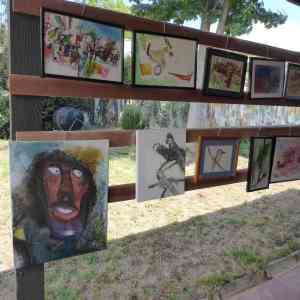
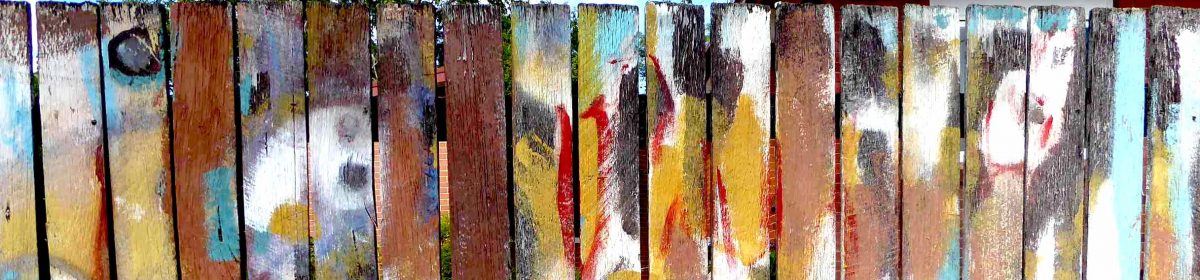
On Saturday in our back yard, we celebrated both – painting and books with our neighbours and friends!

What a splendid way to reach out to others and share beauty! Art is part of life and community. Art is not just for exhibition in galleries and museums.

Through it (art) people communicate to one another their feelings, their most intimate and infinitely varied and poignant thoughts.                                                                                                             -From Dialectical Materialism, Philosophy and Art,                                  by Alexander Spirkin


Have you ever held a neighbourhood art show?

Have you ever attended a neighbourhood art show?

Please comment on your ideas about art, communication and community.

Thanks!


Searching for Significance

I thought I had it. A clever evocative title with a double meaning. During two years of research and writing for a novel based on events in the life of my father W. Lon Hutchison, I used the title: Life Expectancy.

The term Life Expectancy could refer to what people expect from life or to a statistical average of how long someone might expect to live.

Two years after I chose the title, I decided to do a web search to find out more about the definitions of life expectancy.

WHOOPS!

In 2004, Dean Koontz, a well-known USA suspense/horror writer wrote a bestseller titled Life Expectancy. The book by Koontz, has a listing on Wikipedia. Rolling Stone hailed Koontz as “America’s most popular suspense novelist.”

Why didn’t any of the writers and bloggers’ tips that I’d read advise me to check if there already was a book with the title I wanted to use?

I’d written a draft of the book with the title Life Expectancy, had prepared queries to send to several publishers, purchased the domain name lifeexpectancy.info and was ready to launch a blog about writing the book.

Everything came to a dead stop. Better late than never.

I had to find another title. Meanwhile I felt as if my writing project no longer existed, had disappeared, becoming a vague memory of something never completed.

Where to get inspiration for another title?

Online, I read

  • all of Woody Guthrie’s lyrics,
  • phrases from Shakespeare and
  • a list of songs recorded by Johnny Cash.

I re-read some of my favorite poetry books by Kenneth Patchen, Gary Snyder, Eleanor Lerman…

A month of searching, hoping that a title would find me. No luck.

How did you choose the title for you book or books?

What is the significance of a title?

Your comments and feedback are most welcome.

Thanks!


Reading while camping, snorkeling, hiking

So very fortunate to be able to camp at Booderee National Park, Jervis Bay, South Coast of Australia https://parksaustralia.gov.au/booderee/ during the Christmas holidays.

The campground is so beloved that those interested in camping during the holiday season (December-January) have to make a booking in August. THEN wait until September to find out if they have gotten a space.

Every day I went snorkeling (highlights included seeing a giant ray, wobbegong sharks, squid, and an octopus), hiking, and swimming in the crystal clear waters of Jervis Bay.

Reminder: December is summer in Australia

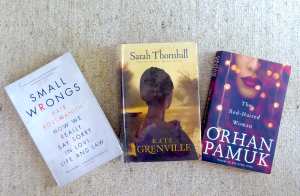
While camping, I  managed to read three books in five days

  • Small Wrongs, How we really say sorry in love, life and law by Kate Rossmanith
  • Sarah Thornhill, sequel to The Secret River by Kate Grenville
  • The Red-Haired Woman by Orhan Pamuk

Small Wrongs was also about big wrongs…that is, major crimes, including murder. The book wrestled with the idea of remorse, what it is and when it happens. According to a New South Wales Judicial Commission official, “Remorse is very important for prisoners because, if they feel genuine remorse, they’re more likely to address their offending behavior and produce positive results during the various prison rehabilitation programs” ( p. 119). But what is “genuine” remorse? And who decides if it is genuine?
Sarah Thornhill is a novel about colonial Australia. The novel reveals how settlers’ massacre of Aboriginal Australians threatened the integrity of their own families despite cover-ups and lies.

The Red Haired Woman is an intriguing story of contradictions and similarities between mythical stories of Europe (Oedipus) and Iran (Shahnameh), both of which focus on violence between father and son. “There were in fact surprising parallels between Oedipus’s life and Sohrab’s. But there was one fundamental difference, too: Oedipus murdered his father while Sohrab was murdered by his father. One is a story of patricide, the other a story of filicide”. p. 141

Thanks to book reviews on Australian Broadcasting Corporation and the public library of the Australian Capital Territory for sharing these books with me.

Enjoy your reading in the coming year and forever!                    Comments most welcome.

Why blog?

Is it to write away sorrow and share joys?

Is it a living memoir?

Is it only for yourself? And maybe a few friends?

Is it to encourage people to continue their own writing or start writing?

Is it to exchange ideas and encourage other writers?

Is it to encourage people to buy and read my book, Tracking the Human: nobody’s a long time when it’s published.

All of the above

Here are some of the people I hope will read my blog and share their comments with me.

  • People who like to read, who learn through reading,
  • People who use the public library regularly.
  • People who are curious about other peoples’ lives and families.
  • People interested in the early to mid twentieth century in the mid West of the United States.
  • People interested in riding the rails, hobo culture, mental hospitals, and Christian Science.
  • People who are writers and write in order to know the world and themselves.

Here are some interesting people that might read my blog:

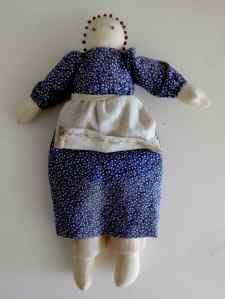
All of the above people were found on a shelf in our front bedroom. All are from an extensive collection of dolls that I inherited from my mother. Everywhere she went, my mother bought a handmade doll.

This person is particularly special:

Can you read what it says at the bottom of her apron?

Rebecca, who longs to travel. 

Rebecca would be my ideal reader… a person who longs to travel, who is curious, who wants to meet new people and exchange ideas.

Welcome to all those Rebeccas (and Robertos) out there.

Enjoy reading family and fiction.

Why do you blog?

Send in your comments.

Thanks!


Who is a Writer?

Rediscovered: 8 Books about Writing

Why I am (not) a writer?   Or am I?

While reading the blog http://howtoplanwriteanddevelopabook.blogspot.com I noticed a list of My Favorite Writing Books by the author of the blog, Mary Carroll Moore.

One book on the list jumped out at me, shouting, Remember me? The title of the book is Bird by Bird by Anne Lamott, subtitle: Some Instructions on Writing and Life.

Yes, I do remember you. At least I remember the title. I wondered if I still had that book.

Searching through my bookshelves, I found it. Paperback. Pages yellowed. Purchased in Berkeley, California, 1995.

Rediscovered: 23 years later in Canberra, Australia.

Finding Bird by Bird was like finding a photo of a member of my family that I had forgotten about or pushed aside. Rediscovering this slim paperback book uncovered layers of myself, buried under years of life, of travel, of work, of family.

Just before I moved back to Canberra, Australia, after living in various countries for 20 years, I gave away 12 cartons of books. I slimmed down considerably. International living does that. Books are bulky and heavy.

Looking through my bookshelves in Canberra, I found more books about writing. There must be a reason why I had not discarded these books.

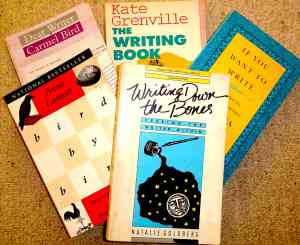
Here they are, listed in no particular order, with the place and year I acquired them.

  • The Writing Book, Kate Grenville, subtitle: A Workbook for Fiction Writers, Canberra, Australia, 1991.
  • Writing Down the Bones, Natalie Goldberg, subtitle: Freeing the Writer Within,  acquired in Berkeley California, 1989.
  • If You Want to Write by Brenda Ueland, subtitle: A Book about Art, Independence and Spirit, originally published in 1938, republished in paperback in 1987. Not sure where I got it.
  • Dear Writer, Carmel Bird, acquired in Canberra, Australia, 1992.
  • Letters to Alice, by Fay Weldon, subtitle: On First Reading Jane Austen, not sure when I acquired this book, published 1986.
  • Writers Inc: A Guide to Writing, Thinking & Learning, several authors, acquired in New York, 1989.
  • Several Short Sentences about Writing, by Verlyn Klinkenborg, acquired in Canberra Australia, 2015.

If I don’t think I am a writer, why for over 20 years, have I carried around to all the continents where I’ve lived so many books about writing?

What have I written during the years of wandering?

  • Features for The Daily Journal (Caracas, Venezuela) and The Chronicle of Higher Education (USA)
  • A book of poetry and sketches, Silence Spoken
  • Numerous letters to the editor of various publications, including The Canberra Times.
  • Edited three books: Bold Plum, with the Guerrillas in China’s War against Japan by Hsiao Li Lindsay; Peace and Milk: Scenes of Northern Somalia by James Lindsay and Fatima Jibrell and Solo vale si piensas rápido by Mehedy Lopez, a book of poetry in Spanish
  • A blog started in memory of my mother, wordpress.com.
  • Currently working on a novel based on events in the life of my father, Tracking the Human, nobody’s a long time

Writing has been embedded throughout my life and my work as an educator.  Yet I struggle to consider myself a “writer”.

How do you define being a writer?

Do you think someone can learn more about writing from a book?

What are your favorite books about writing?  

Are you inspired by books about writing?


Shell Shock

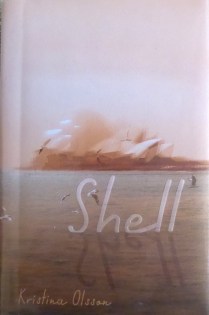
A shell is something beautiful, signifying containment, the protective hard outer layer, yet now empty.

Thus is the novel Shell by Kristina Olsson… beautiful, containing history, events, the 1960s in Australia (1960-1966), the building of the Sydney Opera House, conscription of young men sent to Vietnam, protest, sabotage and families torn apart. P1300633 Shell Front

Shell has flashing moments of insight, of great beauty that resonates, and brings the reader closer to the main character, Pearl Keogh. Her pain at separation from her brothers, who ran away from an orphanage where they were sent after the death of their mother, goes on and on. She’s lost track of her brothers and searches for them, fearful they’ll be conscripted and sent to Vietnam.

When she eventually finds her two younger brothers,  her pain somehow dissipates. They’ve changed. Their values are far apart and irreconcilable from her own. How does Pearl keep going having achieved the goal of finding her brothers, yet realizing that they are farther apart from her than ever? Her calm acceptance of the profound chasm that has opened up between them seems  implausible.

Pearl has an on and off relationship with Axel Lindquist, a Swedish artist working on glass sculpture for the Sydney Opera House. Their time together, their lovemaking, seems random and unfulfilled. Some of the most powerful writing in Shell is of soliloquys when each of them is delving into the loss, pain, guilt and shame of their individual lives.

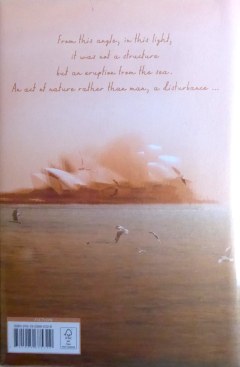
Each character seems to live inside her or his own shell. They don’t quite make contact with others, P1300635 Shell back .jpgincluding family members. Letters between Axel and his mother, who is in Sweden, does portray some warmth in their relationship, but it is at a distance.

Considerable time is taken up in the book regarding the process of glassmaking, which could be a metaphor for their lives and the interrupted process of the construction of the Sydney Opera House.

Shell is a book to admire, to turn over in your mind as you would a beautiful shell in your hand and yet wonder what is missing.

A beautifully written book that somehow disappoints.


Compulsion

I never think of

my  city

my country

As if I own it

I think

I’m here, now

When asked

 Where are you from?

I answer

wherever I’m currently living

– Narrabundah (Australia)

– Nairobi (Kenya)

 No, but where are you really from?

As if that will “place” me

confine me

describe me

 Do I detect a U.S. accent?

 Where are you from in the U.S.?

My (unspoken) reply:

 How much time do you have?

 Do you really want to know my life story?

 All the places I’ve lived and worked

 Is this my identity?